Published on
September 30, 2025
On Monday I spent a day with the Luxembourg Air Rescue (LAR) HEMS (Helicopter Emergency Medical Service) at Findel, almost on their 26th anniversary – LAR was created on 18 April 1988, with the first helicopter arriving almost a year later; the offices are prefabs and hangars are temporary, waiting to move into a purpose-built building in a couple of years' time, just beside the present operational area.
With the possibility of a call coming in at any time – or not at all – the crew were able to explain how LAR HEMS operates. They could not have been more helpful and explained how they operate the helicopters, a bit about the fixed wing aircraft and also from the medical perspective.
So, unless a call came in early, I would have the opportunity to research the background for writing this article, with the possibility of an emergency mission at a moment's notice always at the back of my mind. And theirs.
The research part revealed that LAR had originally been formed by a group of fire-fighters in Luxembourg who had met with significant political and administrative opposition before succeeding due to their belief and perseverance.
With five helicopters in the LAR fleet (apart from the fleet of planes it operates), two are based at hospitals (Air Rescue #1 in Luxembourg City, either the CHL in Strassen, Kirchberg or Zitha Klinik; and Air Rescue #2 at Ettelbruck) and one (Air Rescue #3) in Findel. The LAR HEMS crews are available from 08:00 until sunset, with the Findel HEMS unit responding to both Luxembourg and German emergency callouts; however, normally the Air Rescue #1 and #2 at the hospitals are responding to Luxembourg emergencies, with the Air Rescue #3 flying missions to Rheinland-Palatinate (in and around Trier, as far north as Bitburg and the Eifel region) and sometimes Saarland (down to Merzig, north of Saarbrücken).
Air Rescue #3 also performs Secondary Care Missions for transporting patients between hospitals (for example to transfer a newborn baby with heart problems from the “Kannerklinik” to Brussels). It would be unusual for a Primary Care mission to involve a flight time of more than 10 minutes. A fourth LAR helicopter is used for training, with a fifth on standby or undergoing maintenance. Last year, Air Rescue #3 flew over 1,000 missions.
Each LAR HEMS crew consists of a pilot and a navigator-cum-paramedic who sit up front in the cockpit, with the pilot on the right (no port or starboard terminology used here, although there’s a lot of “o’clock” references to point out positioning of objects relative to the aircraft), and a doctor in the cabin, along with just enough room for a patient stretcher and medical equipment all carefully stowed for emergency use. There is also a jump seat where, for example, a mother can sit to accompany her sick child.
On Air Rescue #1 and #2, the doctors are from the medical services or hospitals, while on Air Rescue #3 (Findel), the doctor is employed directly by LAR.
LAR employs a total of 12 helicopter pilots, all working five days on and five days off, with five pilots on duty each day. Apart from the three assigned to the operational helicopters, another two are assigned to fly the police helicopter, which is also based at Findel.
The LAR helicopters can be ready for take-off in two minutes for Primary Care missions, and within up to 15 minutes for Secondary Care missions. Around 2,000 flying hours are required to fly with LAR, and most of the pilots have military experience.
The LAR (and Luxembourg Police) helicopter fleet consists entirely of McDonnell Douglas MD902 Explorer aircraft, manufactured near Phoenix, Arizona. In addition, LAR operates two Learjet 35As (for single patients, with a maximum flight time of four hours before refuelling) and two Learjet 45XRs (for two patients), all requiring a pilot and co-pilot as well as a doctor and paramedic. These aircraft are used for missions for LAR members and for insurance companies worldwide. The Learjets require one hour of aircraft preparation time, plus up to another hour for medical preparation. For example, a recent mission was to New Delhi in India.
From a medical equipment perspective, 90% of cases can be handled using equipment and medication contained in a single 28kg bag, covering trauma and cardiac cases. Additional cases include suction equipment, a defibrillator, oxygen, and paediatric equipment. They also use various systems, some developed internally, to improve patient care – for example colour-coded straps and treatment packages for children of different sizes, making dosage calculations easier.
In emergencies, reducing the therapy-free interval is critical. The rescue helicopters can bring a doctor with full equipment to the patient as quickly as possible.
First emergency call at 11:05. Pilot, paramedic, doctor and myself on board and strapped in. Clearance obtained from air traffic control and we were airborne. Estimated time of arrival: 7 minutes, just north of Mettlach in Germany.
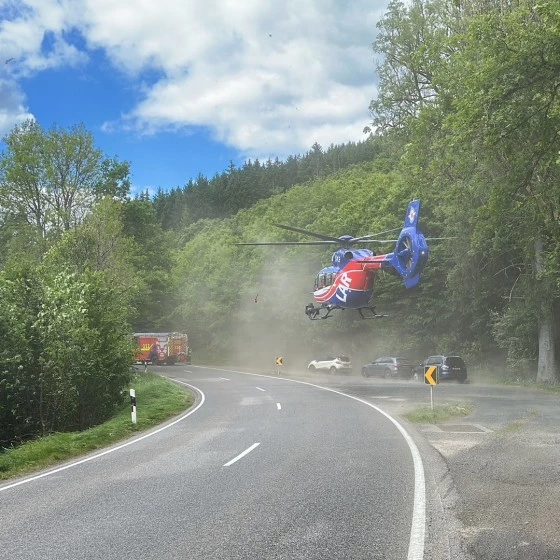
Flying at around 400 metres (800 metres over built-up areas), we passed landmarks such as Schrassig prison and Kikuoka Golf Club in Canach. Following the contours of the rivers, the pilot navigated using GPS and landed beside a graveyard.
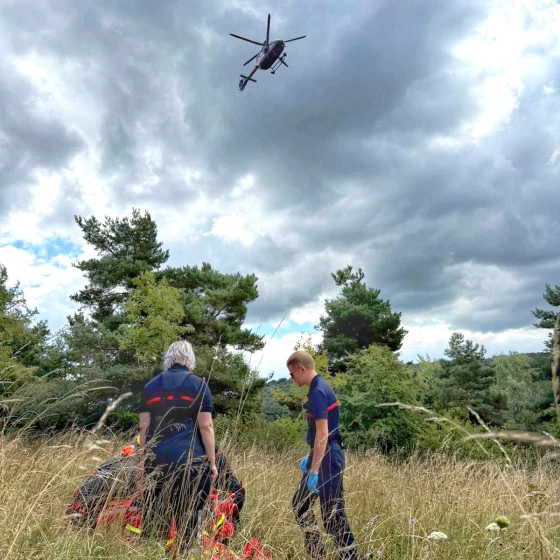
The medical team assisted German paramedics who had arrived just two minutes earlier by ambulance. A farmer had discovered an unconscious man near the road. After handing the patient over, we returned to base.
Less than two minutes after landing, the alarm sounded again. We headed north-east to Gentingen in Germany. Near a campsite, we landed in a field next to a house where an elderly woman had lost consciousness. This time we arrived before the ambulance. After treatment, she was handed over to the German paramedics.
Back in the air, a third call came in but was quickly cancelled. Shortly after, another call directed us to Merzig. We flew south, crossed the Moselle and followed the Saar River.
The patient was in an apartment block, so we landed on a nearby school playground. A police car transported the doctor and paramedic to the patient. While they accompanied the patient to hospital, the pilot flew to a nearby airfield for refuelling.
At Saarlouis-Düren, refuelling was quick and simple. With a 600-litre tank, we took on nearly 200 litres. We then flew to the hospital, picked up the medical team and returned to Findel.
Back at base, paperwork followed and we waited for the next call. But that was it for the day.
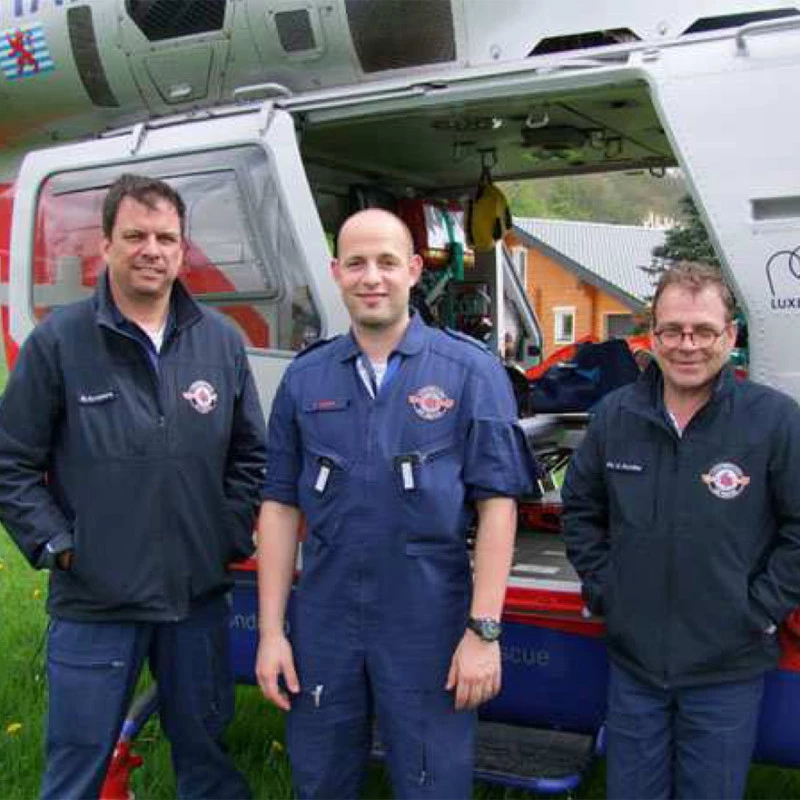
Thanks to pilot Marcel Kurpiers, paramedic Sebastian Hanf and doctor Christoph Schüller for their hospitality and for allowing me a glimpse into their daily work at Luxembourg Air Rescue.
LAR membership costs just €54 per year per person, or €97 for a family. See www.lar.lu for details and benefits.
Photos by Geoff Thompson (above, left to right): pilot Marcel Kurpiers, paramedic Sebastian Hanf and doctor Christoph Schüller

On Monday I spent a day with the Luxembourg Air Rescue (LAR) HEMS (Helicopter Emergency Medical Service) at Findel, almost on their 26th anniversary – LAR was created on 18 April 1988, with the first helicopter arriving almost a year later; the offices are prefabs and hangars are temporary, waiting to move into a purpose-built building in a couple of years' time, just beside the present operational area.
With the possibility of a call coming in at any time – or not at all – the crew were able to explain how LAR HEMS operates. They could not have been more helpful and explained how they operate the helicopters, a bit about the fixed wing aircraft and also from the medical perspective.
So, unless a call came in early, I would have the opportunity to research the background for writing this article, with the possibility of an emergency mission at a moment's notice always at the back of my mind. And theirs.
The research part revealed that LAR had originally been formed by a group of fire-fighters in Luxembourg who had met with significant political and administrative opposition before succeeding due to their belief and perseverance.
With five helicopters in the LAR fleet (apart from the fleet of planes it operates), two are based at hospitals (Air Rescue #1 in Luxembourg City, either the CHL in Strassen, Kirchberg or Zitha Klinik; and Air Rescue #2 at Ettelbruck) and one (Air Rescue #3) in Findel. The LAR HEMS crews are available from 08:00 until sunset, with the Findel HEMS unit responding to both Luxembourg and German emergency callouts; however, normally the Air Rescue #1 and #2 at the hospitals are responding to Luxembourg emergencies, with the Air Rescue #3 flying missions to Rheinland-Palatinate (in and around Trier, as far north as Bitburg and the Eifel region) and sometimes Saarland (down to Merzig, north of Saarbrücken).
Air Rescue #3 also performs Secondary Care Missions for transporting patients between hospitals (for example to transfer a newborn baby with heart problems from the “Kannerklinik” to Brussels). It would be unusual for a Primary Care mission to involve a flight time of more than 10 minutes. A fourth LAR helicopter is used for training, with a fifth on standby or undergoing maintenance. Last year, Air Rescue #3 flew over 1,000 missions.
Each LAR HEMS crew consists of a pilot and a navigator-cum-paramedic who sit up front in the cockpit, with the pilot on the right (no port or starboard terminology used here, although there’s a lot of “o’clock” references to point out positioning of objects relative to the aircraft), and a doctor in the cabin, along with just enough room for a patient stretcher and medical equipment all carefully stowed for emergency use. There is also a jump seat where, for example, a mother can sit to accompany her sick child.
On Air Rescue #1 and #2, the doctors are from the medical services or hospitals, while on Air Rescue #3 (Findel), the doctor is employed directly by LAR.
LAR employs a total of 12 helicopter pilots, all working five days on and five days off, with five pilots on duty each day. Apart from the three assigned to the operational helicopters, another two are assigned to fly the police helicopter, which is also based at Findel.
The LAR helicopters can be ready for take-off in two minutes for Primary Care missions, and within up to 15 minutes for Secondary Care missions. Around 2,000 flying hours are required to fly with LAR, and most of the pilots have military experience.
The LAR (and Luxembourg Police) helicopter fleet consists entirely of McDonnell Douglas MD902 Explorer aircraft, manufactured near Phoenix, Arizona. In addition, LAR operates two Learjet 35As (for single patients, with a maximum flight time of four hours before refuelling) and two Learjet 45XRs (for two patients), all requiring a pilot and co-pilot as well as a doctor and paramedic. These aircraft are used for missions for LAR members and for insurance companies worldwide. The Learjets require one hour of aircraft preparation time, plus up to another hour for medical preparation. For example, a recent mission was to New Delhi in India.
From a medical equipment perspective, 90% of cases can be handled using equipment and medication contained in a single 28kg bag, covering trauma and cardiac cases. Additional cases include suction equipment, a defibrillator, oxygen, and paediatric equipment. They also use various systems, some developed internally, to improve patient care – for example colour-coded straps and treatment packages for children of different sizes, making dosage calculations easier.
In emergencies, reducing the therapy-free interval is critical. The rescue helicopters can bring a doctor with full equipment to the patient as quickly as possible.
First emergency call at 11:05. Pilot, paramedic, doctor and myself on board and strapped in. Clearance obtained from air traffic control and we were airborne. Estimated time of arrival: 7 minutes, just north of Mettlach in Germany.
Flying at around 400 metres (800 metres over built-up areas), we passed landmarks such as Schrassig prison and Kikuoka Golf Club in Canach. Following the contours of the rivers, the pilot navigated using GPS and landed beside a graveyard.
The medical team assisted German paramedics who had arrived just two minutes earlier by ambulance. A farmer had discovered an unconscious man near the road. After handing the patient over, we returned to base.
Less than two minutes after landing, the alarm sounded again. We headed north-east to Gentingen in Germany. Near a campsite, we landed in a field next to a house where an elderly woman had lost consciousness. This time we arrived before the ambulance. After treatment, she was handed over to the German paramedics.
Back in the air, a third call came in but was quickly cancelled. Shortly after, another call directed us to Merzig. We flew south, crossed the Moselle and followed the Saar River.
The patient was in an apartment block, so we landed on a nearby school playground. A police car transported the doctor and paramedic to the patient. While they accompanied the patient to hospital, the pilot flew to a nearby airfield for refuelling.
At Saarlouis-Düren, refuelling was quick and simple. With a 600-litre tank, we took on nearly 200 litres. We then flew to the hospital, picked up the medical team and returned to Findel.
Back at base, paperwork followed and we waited for the next call. But that was it for the day.
Thanks to pilot Marcel Kurpiers, paramedic Sebastian Hanf and doctor Christoph Schüller for their hospitality and for allowing me a glimpse into their daily work at Luxembourg Air Rescue.
LAR membership costs just €54 per year per person, or €97 for a family. See www.lar.lu for details and benefits.
Photos by Geoff Thompson (above, left to right): pilot Marcel Kurpiers, paramedic Sebastian Hanf and doctor Christoph Schüller
On Monday I spent a day with the Luxembourg Air Rescue (LAR) HEMS (Helicopter Emergency Medical Service) at Findel, almost on their 26th anniversary – LAR was created on 18 April 1988, with the first helicopter arriving almost a year later; the offices are prefabs and hangars are temporary, waiting to move into a purpose-built building in a couple of years' time, just beside the present operational area.
With the possibility of a call coming in at any time – or not at all – the crew were able to explain how LAR HEMS operates. They could not have been more helpful and explained how they operate the helicopters, a bit about the fixed wing aircraft and also from the medical perspective.
So, unless a call came in early, I would have the opportunity to research the background for writing this article, with the possibility of an emergency mission at a moment's notice always at the back of my mind. And theirs.
The research part revealed that LAR had originally been formed by a group of fire-fighters in Luxembourg who had met with significant political and administrative opposition before succeeding due to their belief and perseverance.
With five helicopters in the LAR fleet (apart from the fleet of planes it operates), two are based at hospitals (Air Rescue #1 in Luxembourg City, either the CHL in Strassen, Kirchberg or Zitha Klinik; and Air Rescue #2 at Ettelbruck) and one (Air Rescue #3) in Findel. The LAR HEMS crews are available from 08:00 until sunset, with the Findel HEMS unit responding to both Luxembourg and German emergency callouts; however, normally the Air Rescue #1 and #2 at the hospitals are responding to Luxembourg emergencies, with the Air Rescue #3 flying missions to Rheinland-Palatinate (in and around Trier, as far north as Bitburg and the Eifel region) and sometimes Saarland (down to Merzig, north of Saarbrücken).
Air Rescue #3 also performs Secondary Care Missions for transporting patients between hospitals (for example to transfer a newborn baby with heart problems from the “Kannerklinik” to Brussels). It would be unusual for a Primary Care mission to involve a flight time of more than 10 minutes. A fourth LAR helicopter is used for training, with a fifth on standby or undergoing maintenance. Last year, Air Rescue #3 flew over 1,000 missions.
Each LAR HEMS crew consists of a pilot and a navigator-cum-paramedic who sit up front in the cockpit, with the pilot on the right (no port or starboard terminology used here, although there’s a lot of “o’clock” references to point out positioning of objects relative to the aircraft), and a doctor in the cabin, along with just enough room for a patient stretcher and medical equipment all carefully stowed for emergency use. There is also a jump seat where, for example, a mother can sit to accompany her sick child.
On Air Rescue #1 and #2, the doctors are from the medical services or hospitals, while on Air Rescue #3 (Findel), the doctor is employed directly by LAR.
LAR employs a total of 12 helicopter pilots, all working five days on and five days off, with five pilots on duty each day. Apart from the three assigned to the operational helicopters, another two are assigned to fly the police helicopter, which is also based at Findel.
The LAR helicopters can be ready for take-off in two minutes for Primary Care missions, and within up to 15 minutes for Secondary Care missions. Around 2,000 flying hours are required to fly with LAR, and most of the pilots have military experience.
The LAR (and Luxembourg Police) helicopter fleet consists entirely of McDonnell Douglas MD902 Explorer aircraft, manufactured near Phoenix, Arizona. In addition, LAR operates two Learjet 35As (for single patients, with a maximum flight time of four hours before refuelling) and two Learjet 45XRs (for two patients), all requiring a pilot and co-pilot as well as a doctor and paramedic. These aircraft are used for missions for LAR members and for insurance companies worldwide. The Learjets require one hour of aircraft preparation time, plus up to another hour for medical preparation. For example, a recent mission was to New Delhi in India.
From a medical equipment perspective, 90% of cases can be handled using equipment and medication contained in a single 28kg bag, covering trauma and cardiac cases. Additional cases include suction equipment, a defibrillator, oxygen, and paediatric equipment. They also use various systems, some developed internally, to improve patient care – for example colour-coded straps and treatment packages for children of different sizes, making dosage calculations easier.
In emergencies, reducing the therapy-free interval is critical. The rescue helicopters can bring a doctor with full equipment to the patient as quickly as possible.
First emergency call at 11:05. Pilot, paramedic, doctor and myself on board and strapped in. Clearance obtained from air traffic control and we were airborne. Estimated time of arrival: 7 minutes, just north of Mettlach in Germany.
Flying at around 400 metres (800 metres over built-up areas), we passed landmarks such as Schrassig prison and Kikuoka Golf Club in Canach. Following the contours of the rivers, the pilot navigated using GPS and landed beside a graveyard.
The medical team assisted German paramedics who had arrived just two minutes earlier by ambulance. A farmer had discovered an unconscious man near the road. After handing the patient over, we returned to base.
Less than two minutes after landing, the alarm sounded again. We headed north-east to Gentingen in Germany. Near a campsite, we landed in a field next to a house where an elderly woman had lost consciousness. This time we arrived before the ambulance. After treatment, she was handed over to the German paramedics.
Back in the air, a third call came in but was quickly cancelled. Shortly after, another call directed us to Merzig. We flew south, crossed the Moselle and followed the Saar River.
The patient was in an apartment block, so we landed on a nearby school playground. A police car transported the doctor and paramedic to the patient. While they accompanied the patient to hospital, the pilot flew to a nearby airfield for refuelling.
At Saarlouis-Düren, refuelling was quick and simple. With a 600-litre tank, we took on nearly 200 litres. We then flew to the hospital, picked up the medical team and returned to Findel.
Back at base, paperwork followed and we waited for the next call. But that was it for the day.
Thanks to pilot Marcel Kurpiers, paramedic Sebastian Hanf and doctor Christoph Schüller for their hospitality and for allowing me a glimpse into their daily work at Luxembourg Air Rescue.
LAR membership costs just €54 per year per person, or €97 for a family. See www.lar.lu for details and benefits.
Photos by Geoff Thompson (above, left to right): pilot Marcel Kurpiers, paramedic Sebastian Hanf and doctor Christoph Schüller